Artificial intelligence, blockchain, and extended reality: emerging digital technologies to turn the tide on illegal logging and illegal wood trade
DOI:
https://doi.org/10.12899/asr-2435Keywords:
Next-generation blockchain, digital twins, explainable artificial intelligence, extended reality, illegal wood tradeAbstract
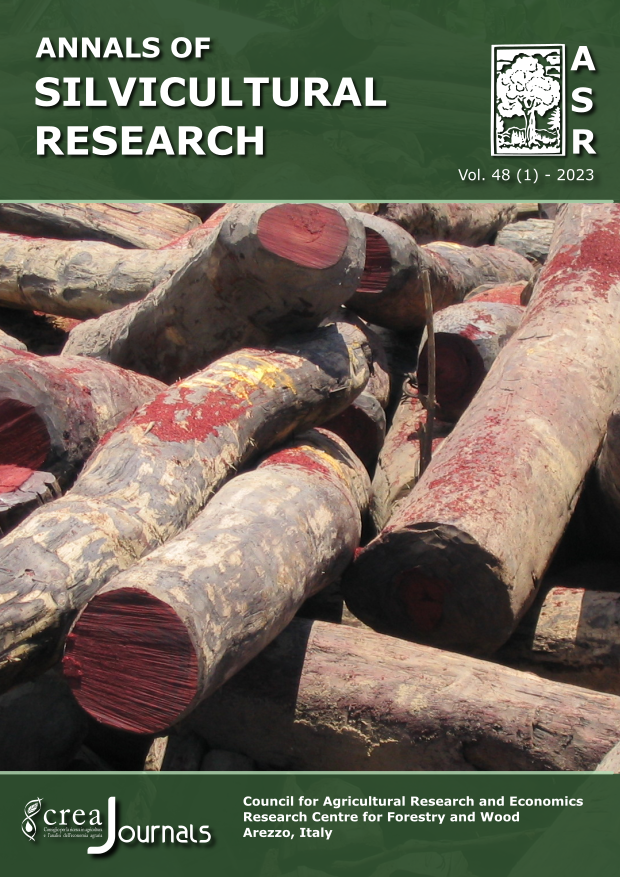
Illegal logging which often results in forest degradation and sometimes in deforestation remains ubiquitous in many places around the globe. Managing illegal logging and illegal wood trade constitutes a global priority over the next few decades. Scientific, technological, and research communities are committed to respond rapidly, evaluating the opportunities to capitalize on emerging digital technologies for treating this formidable challenge. The innovative potentials of these emerging digital technologies at tackling illegal logging-related challenges are here investigated. We propose a novel system, WoodchAInX, combining explainable artificial intelligence (X-AI), next-generation blockchain, and extended reality (XR). Our findings on the most effective means of leveraging each technology’s potential and the convergence of the three technologies infer a vast promise for digital technology in this field. Yet, we argue that, overall, digital transformations will not deliver fundamental, responsible, and sustainable benefits without revolutionary realignment.
References
Bang A., Khadakkar S. 2020 - Biodiversity conservation during a global crisis: consequences and the way forward. In: Proceedings of the National Academy of Sciences 117 (48): 29995–29999. doi:10.1073/pnas.2021460117
Brandt M., Tucker C. J., Kariryaa A., Rasmussen K., Abel C., Small J., Chave J., Rasmussen L. V., Hiernaux P., Diouf A. A., Kergoat L., Mertz O., Igel C., Gieseke F., Schöning J., Li S., Melocik K., Meyer J., Sinno S. et al. 2020 - An unexpectedly large count of trees in the West African Sahara and Sahel. Nature 587 (7832): 78–82. doi:10.1038/s41586-020-2824-5
Corona P. 2018 - Communicating facts, findings and thinking to support evidence-based strategies and decisions. Annals of Silvicultural Research 42: 1-2. doi: 10.12899/ASR-1617
Dormontt E. E., Boner M., Braun B., Breulmann G., Degen B., Espinoza E., Gardner S., Guillery P., Hermanson J. C., Koch G., Lee S. L., Kanashiro M., Rimbawanto A., Thomas D., Wiedenhoeft A. C., Yin Y., Zahnen J., Lowe A. J. 2015 - Forensic timber identification: it’s time to integrate disciplines to combat illegal logging. Biological Conservation 191: 790–798. doi:10.1016/j.biocon.2015.06.038
Felipe M., Zhang K., Shahzad A., Ouhimmou M. 2021 - LogLog: a blockchain solution for tracking and certifying wood volumes. In: proceeding 2021 IEEE International Conference on Blockchain and Cryptocurrency (ICBC). S. Kanhere (Ed.), Sydney, Australia, IEEE doi:10.1109/ICBC51069.2021.9461153
Feng D., Liu Y., Mazloomi M. S., Limaye A., Turner M., Evans P. D. 2020 - A virtual reality system to augment teaching of wood structure and protection. International Wood Products Journal 11 (2): 46–56. doi:10.1080/20426445.2020.1737773
Forest Learning 2021 - ForestVR. [Online] Available: https://forestlearning.edu.au/forestvr.html. [October 4, 2022]
Gervais A., Karame G. O., Wüst K., Glykantzis V., Ritzdorf H., Capkun S. 2016 - On the security and performance of proof of work blockchains. In: Proceedings of the 2016 ACM SIGSAC Conference on Computer and Communications Security. E. Weippl (Ed.), New York, USA, ACM doi:10.1145/2976749.2978341
Gibbs E. P. J. 2014 - The evolution of One Health: a decade of progress and challenges for the future. Veterinary Record 174 (4): 85–91. doi:10.1136/vr.g143
Glausiusz J. 2020 - Wood — the vein that runs through human history. Nature 588 (7836): 26–27. doi:10.1038/d41586-020-03378-y
Grant J., Keong Chen H. 2021 - Using wood forensic science to deter corruption and illegality in the timber trade. Targeting Natural Resource Corruption: Topic Brief
Haber S., Stornetta W. S. 1991 - How to time-stamp a digital document. Journal of Cryptology 3 (2): 99–111. doi:10.1007/BF00196791
Hanan N. P., Anchang J. Y. 2020 - Satellites could soon map every tree on Earth. Nature 587 (7832): 42–43. doi:10.1038/d41586-020-02830-3
Harfouche A. L., Jacobson D. A., Kainer D., Romero J. C., Harfouche A. H., Scarascia Mugnozza G., Moshelion M., Tuskan G. A., Keurentjes J. J. B., Altman A. 2019 - Accelerating climate resilient plant breeding by applying next-generation artificial intelligence. Trends in Biotechnology 37 (11): 1217–35. doi:10.1016/j.tibtech.2019.05.007
Harfouche A. L., Nakhle F. 2020 - Creating bioethics distance learning through virtual reality. Trends in Biotechnology 38 (11): 1187–1192. doi:10.1016/j.tibtech.2020.05.005
Harfouche A. L., Nakhle F., Harfouche A. H., Sardella O. G., Dart E., Jacobson D. 2022 - A primer on artificial intelligence in plant digital phenomics: embarking on the data to insights journey. Trends in Plant Science doi:10.1016/j.tplants.2022.08.021
Harfouche A. L., Petousi V., Meilan R., Sweet J., Twardowski T., Altman A. 2021 - Promoting ethically responsible use of agricultural biotechnology. Trends in Plant Science 26 (6): 546–559. doi:10.1016/j.tplants.2020.12.015
Harfouche A., Romagnoli M., Corona P. 2022 - Under the “publish or perish” mantra and the race for grants, insights to catalyze research into wood science. Annals of Silvicultural Research 47 (2). doi:http://dx.doi.org/10.12899/asr-2407
Interpol 2021 - Forestry crime. [Online] Available: https://www.interpol.int/en/Crimes/Environmental-crime/Forestry-crime. [October 4, 2022]
Jiang X., Jiang M., Gou Y., Li Q., Zhou Q. 2022 - Forestry digital twin with machine learning in Landsat 7 data. Frontiers in Plant Science 13: 916900. doi:10.3389/fpls.2022.916900
Jones I. J., MacDonald A. J., Hopkins S. R., Lund A. J., Liu Z. Y.-C., Fawzi N. I., Purba M. P., Fankhauser K., Chamberlin A. J., Nirmala M., Blundell A. G., Emerson A., Jennings J., Gaffikin L., Barry M., Lopez-Carr D., Webb K., De Leo G. A., Sokolow S. H. 2020 - Improving rural health care reduces illegal logging and conserves carbon in a tropical forest. In: Proceedings of the National Academy of Sciences 117 (45): 28515–24. doi:10.1073/pnas.2009240117
Kırbaş İ., Çifci A. 2022 - An effective and fast solution for classification of wood species: a deep transfer learning approach. Ecological Informatics 69: 101633. doi:10.1016/j.ecoinf.2022.101633
Komdeur E. F. M., Ingenbleek P. T. M. 2021 - The potential of blockchain technology in the procurement of sustainable timber products. International Wood Products Journal 12 (4): 249–257. doi:10.1080/20426445.2021.1967624
Kwon O., Lee H. G., Yang S.-Y., Kim H., Park S.-Y., Choi I.-G., Yeo H. 2019 - Performance enhancement of automatic wood classification of Korean softwood by ensembles of convolutional neural networks. Journal of the Korean Wood Science and Technology 47 (3): 265–276. doi:10.5658/WOOD.2019.47.3.265
Liu S., He T., Wang J., Chen J., Guo J., Jiang X., Wiedenhoeft A. C., Yin Y. 2022 - Can quantitative wood anatomy data coupled with machine learning analysis discriminate CITES species from their look-alikes? Wood Science and Technology 56 (5): 1567–1583. doi:10.1007/s00226-022-01404-y
Lowe A. J., Dormontt E. E., Bowie M. J., Degen B., Gardner S., Thomas D., Clarke C., Rimbawanto A., Wiedenhoeft A., Yin Y., Sasaki N. 2016 - Opportunities for improved transparency in the timber trade through scientific verification. BioScience 66 (11): 990–998. doi:10.1093/biosci/biw129
Loy A. C. M., Lim J. Y., How B. S., Yoo C. K. 2022 - Blockchain as a frontier in biotechnology and bioenergy applications. Trends in Biotechnology 40 (3): 255–258. doi:10.1016/j.tibtech.2021.09.006
Mason J., Parker-Forney M. 2018 - DNA testing can save trees from illegal logging – and you can help. [Online] Available: https://www.wri.org/insights/dna-testing-can-save-trees-illegal-logging-and-you-can-help. [October 4, 2022]
Nakamoto S. 2008 - Bitcoin: a peer-to-peer electronic cash system [Online] Available: https://bitcoin.org/bitcoin.pdf. [October 4, 2022]
Nakhle F., Harfouche A. 2022 - Extended reality gives digital agricultural biotechnology a new dimension. Trends in Biotechnology doi:https://doi.org/10.1016/j.tibtech.2022.09.005
Nogueron R., Cheung L., Kaldjian E. 2016 - 5 technologies help thwart illegal logging by tracing wood’s origin. [Online] Available: https://www.wri.org/insights/5-technologies-help-thwart-illegal-logging-tracing-woods-origin. [October 4, 2022]
Nature Computational Science Editorial 2022 - A look back at 2021. Nature Computational Science 2 (1): 1–1. doi:10.1038/s43588-022-00195-3
Orts-Escolano S., Rhemann C., Fanello S., Chang W., Kowdle A., Degtyarev Y., Kim D., Davidson P. L., Khamis S., Dou M., Tankovich V., Loop C., Cai Q., Chou P. A., Mennicken S., Valentin J., Pradeep V., Wang S., Kang S. B. et al. 2016 - Holoportation. In: Proceedings of the 29th Annual Symposium on User Interface Software and Technology. New York, NY, USA, ACM doi:10.1145/2984511.2984517
Parkes M., Waltner-Toews D., Horwitz P. 2014 - Ecohealth. In: "Encyclopedia of Quality of Life and Well-Being Research." A. Michalos (Ed.), Dordrecht, Springer Netherlands doi:10.1007/978-94-007-0753-5_4172
Planetary Health Alliance 2022 - Planetary Health. [Online] Available: https://www.planetaryhealthalliance.org/planetary-health. [October 4, 2022]
Rabinowitz P. M., Pappaioanou M., Bardosh K. L., Conti L. 2018 - A planetary vision for one health. BMJ Global Health 3 (5): e001137. doi:10.1136/bmjgh-2018-001137
Rahman A., Yella S., Dougherty M. 2011 - Image processing technique to count the number of logs in a timber truck. In: "Signal and Image Processing (SIP 2011)". K. Ramamohan Rao (Ed.),. Dallas, USA, ACTAPRESS doi:10.2316/P.2011.759-060
Ravindran P., Costa A., Soares R., Wiedenhoeft A. C. 2018 - Classification of CITES-listed and other neotropical Meliaceae wood images using convolutional neural networks. Plant Methods 14 (1): 25. doi:10.1186/s13007-018-0292-9
Resente G., Gillert A., Trouillier M., Anadon-Rosell A., Peters R. L., von Arx G., von Lukas U., Wilmking M. 2021 - Mask, train, repeat! artificial intelligence for quantitative wood anatomy. Frontiers in Plant Science 12: 767400. doi:10.3389/fpls.2021.767400
Rudin C. 2019 - Stop explaining black box machine learning models for high stakes decisions and use interpretable models instead. Nature Machine Intelligence 1 (5): 206–15. doi:10.1038/s42256-019-0048-x
Shugar A. N., Drake B. L., Kelley G. 2021 - Rapid identification of wood species using XRF and neural network machine learning. Scientific Reports 11 (1): 17533. doi:10.1038/s41598-021-96850-2
Sipthorpe A., Brink S., Van Leeuwen T., Staffell I. 2022 - Blockchain solutions for carbon markets are nearing maturity. One Earth 5 (7): 779–791. doi:10.1016/j.oneear.2022.06.004
Spets B. 2022 - Digital Forest Twin. [Online] Available: https://www.tietoevry.com/en/industries/forest-pulp-paper-and-fibre/forest-solutions/wood-and-fibre-ecosystem-and-integration/digital-forest-twin/ [October 4, 2022]
Streich J., Romero J., Gazolla J. G. F. M., Kainer D., Cliff A., Prates E. T., Brown J. B., Khoury S., Tuskan G. A., Garvin M., Jacobson D., Harfouche A. L. 2020 - Can exascale computing and explainable artificial intelligence applied to plant biology deliver on the United Nations sustainable development goals? Current Opinion in Biotechnology 61: 217–25. doi:10.1016/j.copbio.2020.01.010
Tao F., Qi Q. 2019 - Make more digital twins. Nature 573 (7775): 490–491. doi:10.1038/d41586-019-02849-1
TIME USA 2019 - Go inside the Amazon rain forest with TIME’s AR experience. [Online] Available: https://time.com/longform/inside-amazon-rain-forest-vr-app/ [October 4, 2022]
Vilkov A., Tian G. 2019 - Blockchain as a solution to the problem of illegal timber trade between Russia and China: SWOT analysis. International Forestry Review 21 (3): 385–400. doi:10.1505/146554819827293231
World Wildlife Fund 2021 - Forests for a living planet. [Online] Available: https://awsassets.panda.org/downloads/living_forests_chapter_1_26_4_11.pdf. [October 4, 2022]
World Wildlife Fund 2020 - WWF Forests. [Online]Available: https://www.worldwildlife.org/pages/wwf-forests [October 4, 2022]
Downloads
Published
Versions
- 2023-06-23 (2)
- 2023-01-17 (1)
How to Cite
Issue
Section
Categories
License
Copyright (c) 2023 Antoine Harfouche, Farid Nakhle

This work is licensed under a Creative Commons Attribution 4.0 International License.
Authors who publish with this journal agree to the following terms: Authors retain copyright and grant the journal right of first publication with the work simultaneously licensed under a Creative Commons Attribution License that allows others to share the work with an acknowledgement of the work's authorship and initial publication in this journal. Authors are able to enter into separate, additional contractual arrangements for the non-exclusive distribution of the journal's published version of the work (e.g., post it to an institutional repository or publish it in a book), with an acknowledgement of its initial publication in this journal. Authors are permitted and encouraged to post their work online (e.g., in institutional repositories or on their website) prior to and during the submission process, as it can lead to productive exchanges, as well as earlier and greater citation of published work (See The Effect of Open Access).