Survival and growth of 711 forest tree taxa in eight French arboretums from three different climate regions
DOI:
https://doi.org/10.12899/asr-2325Keywords:
Myrtaceae, Pinaceae, Adaptation, Climate Change, Common Garden, Ecological Restoration, PhenotypeAbstract
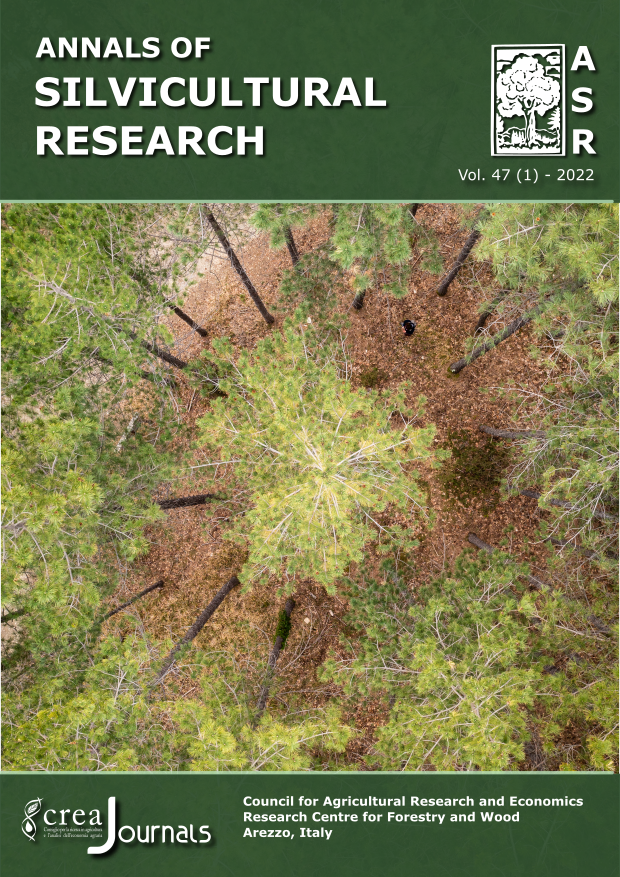
Arboretums have been used for decades for scientific, educational, horticultural and aesthetic purposes. Recently, climate change concerns have renewed the interest of the scientific community for these invaluable experimental forest systems. Here, we report a dataset from eight scientific arboretums planted in three contrasted French metropolitan bioclimates: Oceanic, Mountain and Mediterranean. In total, 92,236 trees were planted in 3,678 different plots. Originating from a worldwide range of habitats, from sea-level up to 3,670 m in elevation, the collection spans 711 forest tree taxa (species, subspecies and varieties) from 177 genera. Taxa often include several geographic sources (so-called provenances), often simultaneously in different arboretums, making within species analyses possible. Cool-climate temperate Pinaceae (pines, firs, spruces, hemlocks, etc.) are well represented in the Atlantic and Mountain arboretums while Mediterranean arboretums are particularly rich with genera from the Myrtaceae (mostly eucalypts) and the Pinaceae (mostly pines). Data include survival, growth (height and diameter) and health status. Planted between 1969 and 1976, 338 taxa had survived at time of assessment and occurred as at least one individual in one plot. Data can be used to assess species suitability for ecological restoration and afforestation, and to help improve functional niche modeling. Data accessibility: https://data.inrae.fr/dataset.xhtml?persistentId=doi:10.15454/RGMM07.
References
Allemand P. 1989 - Espèces exotiques utilisables pour la reconstitution du couvert végétal en région méditerranéenne. Bilan des arboretums forestiers d’élimination. Paris. INRA. 146 p. (Coll. Techniques et pratiques). ISSN : 2-7380-0177-7.
Allemand P., Augé P., Birot Y., Ferrandes P. 1985 - Premiers enseignements des effets du froid de janvier 1985 sur les espèces étudiées en arboretums et en plantations comparatives de provenances en région méditerranéenne française. Forêt méditerranéenne VII (1): 85-90.
Angiosperm Phylogeny Group 2009 - An update of the Angiosperm Phylogeny Group classification for the orders and families of flowering plants: APG III", Botanical Journal of the Linnean Society 161(2): 105–121. doi:10.1111/j.1095-8339.2009.00996.x.
Bastien J.C. 1988 - Premiers enseignements des arboretums d’élimination de Basse-Seine. Revue Forestière Française XL (2): 108-116.
Bastien J.C., Imbert P., Vallance M. 1990 - Choix des espèces pour le reboisement en haute altitude. Premiers enseignements de l'arboretum Curie (Col des Trois-Soeurs - Lozère - alt. : 1,470m). Revue Forestière Française XLII (5): 495-509.
Benito Garzón M., Robson T. M., Hampe A. 2019 - ΔTrait SDMs: species distribution models that account for local adaptation and phenotypic plasticity. New Phytologist 222 (4): 1757-1765. https://doi.org/10.1111/nph.15716
Bimont S. 2012 - Proposition d’essences d’avenir dans le contexte des changements climatiques. Rapport de stage BTS option « gestion forestière ». CGAF INRA Orléans. 34 p.
Canellas C., Gibelin A.-L., Lassègues P., Kerdoncuff M., Dandin P., Simon P. 2014 - Les normales climatiques spatialisées Aurelhy 1981-2010 : températures et précipitations. La Météorologie 201 : 47–55. https://doi.org/10.4267/2042/53750.
Choat B., Brodribb T.J., Brodersen C.R., Duursma R.A., López R., Medlyn B.E. 2018 - Triggers of tree mortality under drought. Nature 558 : 531–539. https://doi.org/10.1038/s41586-018-0240-x
Conjard S. 2015 - Premier bilan des arboretums communs à l'INRA et l’ONF. Essai d’analyse des capacités d’acclimatation des espèces en fonction de leur origine biogéographique. Mémoire de stage M2. Sciences du Territoire. Mention « systèmes territoriaux, aide à la décision, environnement ». Université Joseph Fourier. Grenoble.
Ducatillion C., Badeau V., Bellanger R., Buchlin S., Diadema K., Gili, A., Thévenet J. 2015 - Détection précoce du risque d’invasion par des espèces végétales exotiques introduites en arboretum forestier dans le sud-est de la France. Émergence des espèces du genre Hakea. Mesures de gestion. Revue d’Ecologie (Terre et Vie) 70 : 139-150.
Dow C. 1914 - Forest Arboreta. The American Midland Naturalist 3(9): 255-265. https://doi.org/10.2307/2992750
Fady B., Thévenet J. 2006 - Les arboretums : un outil de recherche et d’éducation sur la biodiversité forestière. Le cas de l’arboretum du Ruscas (Var). Forêt méditerranéenne 27(3) : 235-246.
Fady B., Aravanopoulos F., Benavides R., González-Martínez S., Grivet D., Lascoux M., Lindner M., Rellstab C., Valladares F., Vinceti B. 2020 - Genetics to the rescue: managing forests sustainably in a changing world. Tree Genetics & Genomes 16(6): 1-11. https://doi.org/10.1007/s11295-020-01474-8.
Guijarro J.A. 2019 - climatol: Climate Tools (Series Homogenization and Derived Products). R package version 3.1.2. https://CRAN.R-project.org/package=climatol.
IPCC 2021 - Climate Change 2021: The Physical Science Basis. Contribution of Working Group I to the Sixth Assessment Report of the Intergovernmental Panel on Climate Change [Masson-Delmotte, V., P. Zhai, A. Pirani, S.L., Connors, C. Péan, S. Berger, N. Caud, Y. Chen, L. Goldfarb, M.I. Gomis, M. Huang, K. Leitzell, E. Lonnoy, J.B.R., Matthews, T.K. Maycock, T. Waterfield, O. Yelekçi, R. Yu, and B. Zhou (eds.)]. Cambridge University Press. In Press.
Kirichenko N., Kenis M. 2016 - Using a botanical garden to assess factors influencing the colonization of exotic woody plants by phyllophagous insects. Oecologia 182 : 243–252. https://doi.org/10.1007/s00442-016-3645-y
Langlet O. 1971 - Two hundred years genecology. Taxon : 653-721. https://doi.org/10.2307/1218596.
Mons D. 1993 - Bilan de trois arboretums d’altitude dans le Massif-Central. Rapport de stage pour l’obtention du Brevet de Technicien Supérieur. ONF/INRA. 124 p. et annexes.
Pestour J.L. 1984 - Choix des espèces de reboisement en région méditerranéenne : premier bilan des arboretums d’élimination. Mémoire de fin d’études. ENITEF.
Plomion C., Bastien C., Bogeat-Triboulot M-B., Bouffier L., Déjardin A., Duplessis S., Fady B., Heuertz M., Le Gac A-L., Le Provost G., Legué V., Lelu-Walter M-A., Leplé J-C., Maury S., Morel A., Oddou-Muratorio S., Pilate G., Sanchez L., Scotti I., Scotti-Saintagne C., Segura V., Trontin J-F., Vacher V. 2016 - Forest tree genomics: 10 achievements from the past 10 years and future prospects. Annals of Forest Science 73: 77-103. https://doi.org/10.1007/s13595-015-0488-3.
Primack R.B., Miller‐Rushing A.J. 2009 - The role of botanical gardens in climate change research. New Phytologist 182(2) : 303-313. https://doi.org/10.1111/j.1469-8137.2009.02800.x.
R Core Team 2021 - R: A language and environment for statistical computing. R Foundation for Statistical Computing, Vienna, Austria. https://www.R-project.org/.
Roques A., Fan J.T., Courtial B., Zhang Y.Z., Yart A., Auger-Rozenberg M.A., et al. 2015 - Planting sentinel European trees in Eastern Asia as a novel method to identify potential insect pest invaders. PLoS ONE 10(5): e0120864. https://doi.org/10.1371/journal.pone.0120864
Vetaas O.R. 2002 - Realized and potential climate niches: a comparison of four rhododendron tree species. Journal of Biogeography 29: 545 554. https://doi.org/10.1046/j.1365-2699.2002.00694.x.
Vincent H., Bornand C.N., Kempel A., Fischer M. 2020 - Rare species perform worse than widespread species under changed climate. Biological Conservation 246: 108586. https://doi.org/10.1016/j.biocon.2020.108586.
Walsh B.S., Parratt S.R., Hoffmann A.A., Atkinson D., Snook R.R., Bretman A., Price T.A. 2019 - The impact of climate change on fertility. Trends in Ecology & Evolution 34(3): 249-259. https://doi.org/10.1016/j.tree.2018.12.002.
Walter H., Lieth H. 1960 - Klimadiagramm Weltatlas. Gustav Fischer Verlag, Jena, Germany.
Downloads
Additional Files
Published
How to Cite
Issue
Section
Categories
License
Copyright (c) 2022 Catherine Ducatillion, Thierry Lamant, Richard Bellanger, Valentin Bouttier, Jean-Charles Bastien, Célia Michotey, Laurent Gautier, Bruno Fady, Brigitte Musch

This work is licensed under a Creative Commons Attribution 4.0 International License.
Authors who publish with this journal agree to the following terms: Authors retain copyright and grant the journal right of first publication with the work simultaneously licensed under a Creative Commons Attribution License that allows others to share the work with an acknowledgement of the work's authorship and initial publication in this journal. Authors are able to enter into separate, additional contractual arrangements for the non-exclusive distribution of the journal's published version of the work (e.g., post it to an institutional repository or publish it in a book), with an acknowledgement of its initial publication in this journal. Authors are permitted and encouraged to post their work online (e.g., in institutional repositories or on their website) prior to and during the submission process, as it can lead to productive exchanges, as well as earlier and greater citation of published work (See The Effect of Open Access).